That Age Do You Put Your Baby in a Frount Fasing Carseat
The nation'due south summit scientists, researchers, and physicians recommend that kids sit down rear-facing in the car for every bit long as possible, because rear-facing is safer. Here's why your 2, 3, 4 or even 5 yr old should be riding rear-facing.
The American University of Pediatrics (AAP) has for 20+ years recommended keeping kids rear-facing until they are as well big for rear-facing in their convertible seat. The AAP reiterated this in their 2018 policy argument.
The National Highway Traffic Safe Administration (NHTSA) also updated their recommendations, now specifying that children remain rear-facing until reaching "the elevation height or weight limit allowed by your machine seat'southward manufacturer."
The main questions we get concerning extended rear-facing have to do with WHY it's safer, and HOW bigger kids can stay comfortable rear-facing (jump there now). Information technology'south a big topic merely nosotros've tried to address it conspicuously and thoroughly here. Please let us know if you accept questions about this critical condom outcome!
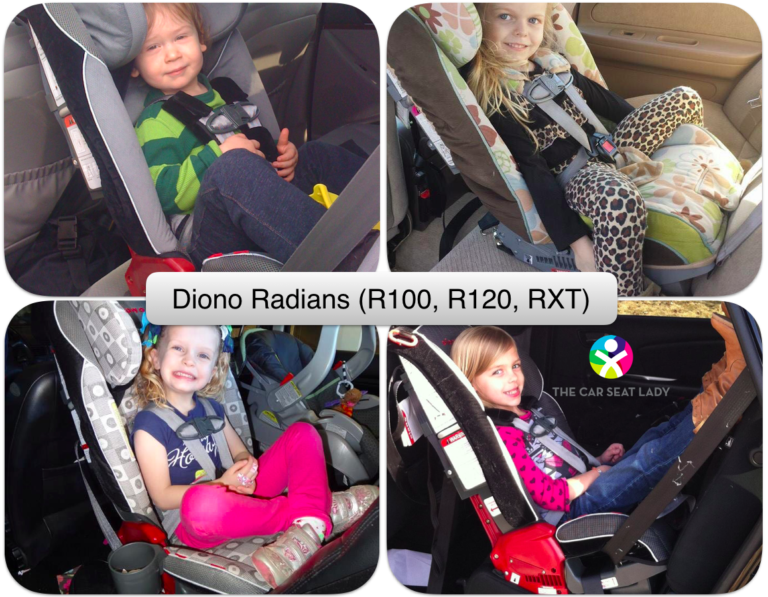
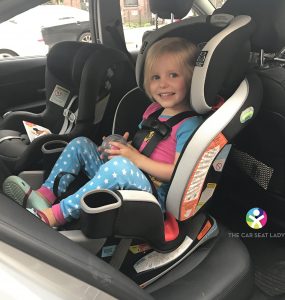
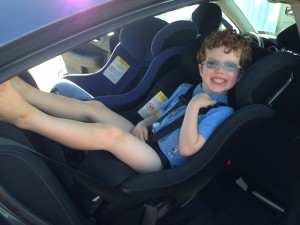
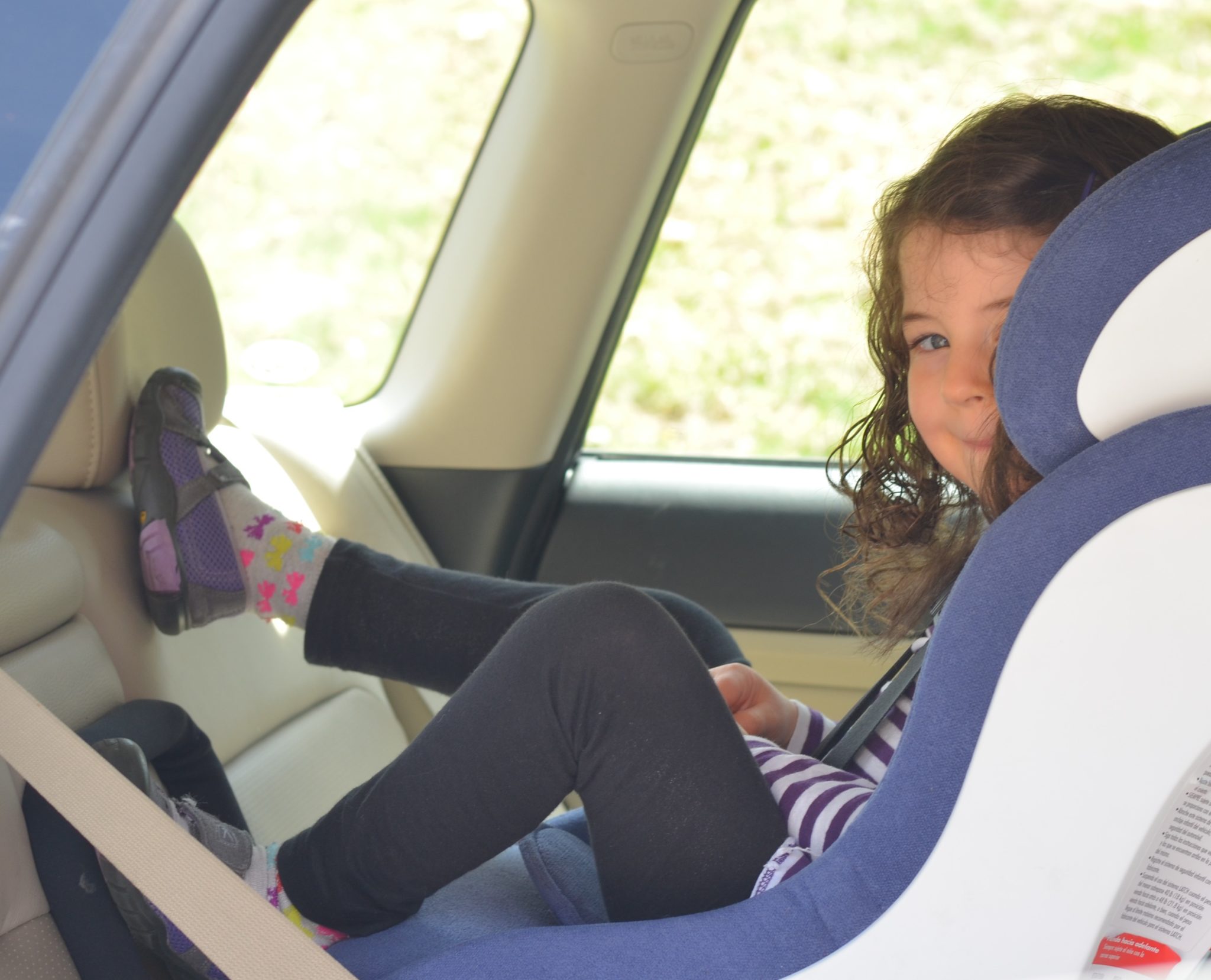
Rear-facing: Not Just for Babies
Why 2, three, 4, and even 5 year olds should be rear-facing!
The American University of Pediatrics (AAP) has for 20+ years recommended keeping kids rear-facing until they are too big for rear-facing in their convertible seat. This was reiterated in their 2018 policy argument.
The National Highway Traffic Safety Assistants (NHTSA) also updated their recommendations, now specifying that children remain rear-facing until reaching "the top meridian or weight limit allowed by your car seat's manufacturer."
Our Favorite Seats for
Keeping Big Kids Rear-facing
Clek FoonfSplurge-worthy, loftier capacity rear-facing seat with max safety features: anti-rebound bar and rear-facing tether. Optimized for installation on side seats. Narrow outside and wide interior gives child max room while taking upwards less room in car than many infant seats. Likewise has max prophylactic features for forward-facing: rigid LATCH + crumple zone.Buy HereClek FlloHigh capacity rear-facing seat with max safety features: anti-rebound bar and rear-facing tether. Optimized for installation in eye seat. Narrow exterior and wide interior gives kid max room. Great in three-across when RF in center seat.Purchase HereGraco Extend2FitHighest rear-facing capacity of any seat in United states for both tallest and heaviest kids. Fits well in small cars behind tall drivers while giving child lots of leg room. Budget friendly! Note: we do not recommend the Platinum or 4Ever models – nosotros like the basic ii-in-1 model all-time!Purchase Here
Previous
Next
15 states now require kids to remain rear-facing until at to the lowest degree their 2nd birthday.
Whoa… you might be thinking "how does a 2-year-old fit rear-facing"… accept 90 seconds and watch the following video – and you'll see how these 90 different 2 year olds all ride safely and comfortably rear-facing.
Common Questions about Rear-facing
Why is rear-facing safer than forwards-facing?
Instead of having your head pull violently away from your chest, as happens when you are forward-facing in a frontal crash, the rear-facing child is cradled in their seat in much the same manner every bit yous catch a fastball in a paw.
This video shows ii 12-month-old crash test dummies each secured in the same car seat merely ane is rear-facing and one is forrard-facing – watch how much the forward-facing dummy'southward head and neck move – and remember that this video is slowed down tremendously every bit crashes happen quicker than the glimmer of an eye. For more than on the physics behind why rear-facing is safer, meet here.
What nearly their legs? Isn't it dangerous and/or uncomfortable?
The video higher up shows a side by side comparison of a forward-facing automobile seat (on the left) and a rear-facing car seat (on the correct) using the same crash examination dummy and the same crash speed.
Notice how the rear-facing dummy tucks into a cannonball position? No matter how scrunched the rear-facing child's legs beginning, they stop up super scrunched during the crash and it does Not cause injury to the legs (or other parts of the body either).There are ZERO documented cases of rear-facing children breaking their legs, hips, feet, etc., due to their feet touching the back of the vehicle seat. In fact, studies prove that forward-facing kids suffer many more leg injuries than rear-facing kids. The leg injuries to forward-facing children occur when the child's legs fly upward and hit the dorsum of the front seat all the while the kid & car seat are moving forward which traps the child's legs and puts tremendous pressure into the leg bones which tin can break them.
What you should be asking is "What about the Caput & Cervix?" – notice how the forward-facing child's caput and neck are thrown forward (snug straps only hold the breast back, not the head & cervix) – whereas the rear-facing child's head and cervix are cradled inside the vanquish of the machine seat. The forrad-facing child'southward head being thrown violently forward IS a crusade for brain and spinal cord injury… injury we tin can prevent past keeping a child rear-facing.
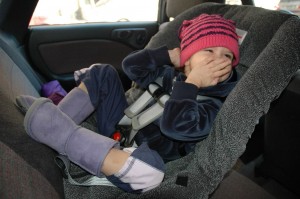
three-year-old happily rear-facing
Besides worrying about leg injuries, many parents worry nigh leg discomfort in the rear-facing kid. Equally kids get older, their feet will touch the back of the vehicle seat; this is both comfortable and safe. Ever wonder why a v-year-old can sleep comfortably with his chin on his chest and never wake up complaining of a potent neck? Information technology's considering kids' joints aren't fully formed, which lets them sit comfortably in positions that would be painful for fifty-fifty a yoga primary. Kids have much more than flexibility and range of motion in their talocrural joint, knee joint and hip joints than we do. For this reason, a 3-year-former can sit comfortably rear-facing with her legs crossed or in the "frog leg" position.
Parents of forward-facing children will know that the kids often effort and put their feet up wherever they can – often the back of the front end seat (which drives many adults crazy!). Frontwards-facing kids are doing this as just like you aren't comfortable when yous sit on a bar stool without a pes residuum and your legs are left to dangle, they don't similar their legs dangling in the auto seat as happens forward-facing (only doesn't happen rear-facing).
What almost rear-facing in a rear-end crash?
A recent written report looked at rear-facing machine seats in rear impacts. They written report found that rear-facing car seats mitigate and manage crash forces in a variety of ways that allow them to provide practiced protection for rear-facing kids. This finding is backed up by epidemiological and field data which also show that real kids riding rear-facing in real rear-terminate crashes typically exercise very well.
Someone told me I tin turn my kid forward-facing at i year and 20 pounds. Is this correct?
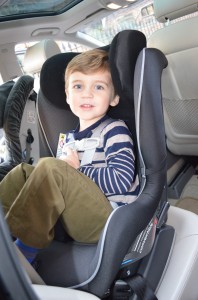
This is NOT correct. Many years ago, in the days before the iPhone was invented, the minimum to plough forward facing was i year and 20 pounds.
In 2011 both the AAP and NHTSA updated their recommendations to reflect the latest research in child passenger rubber. The AAP at present recommends that kids sit rear-facing until at least age 2. NHTSA now recommends: "Your kid should remain in a rear-facing car seat until he or she reaches the top height or weight limit allowed by your car seat'southward manufacturer."
But my child's convertible automobile seat only goes to twenty or 22 pounds rear-facing. What exercise I do?
Our authorities requires manufacturers to include some exceptionally confusing wording on the labels of every convertible auto seat (car seats that outset out rear-facing & then go forward-facing). The sentence that confuses most is "Utilize only in a rear-facing position when using information technology with an infant weighing less than 20 lbs." What this sentence is trying to say, is that for kids who counterbalance less than 20 lbs. the only direction y'all are allowed to install this car seat is rear-facing – i.e. a child under xx pounds may never ride forward-facing in this car seat. However, many people confuse this to mean that later on 20 pounds you must turn the motorcar seat forward-facing – which is NOT what information technology is trying to say. In some other sentence, likely very close to where you found the disruptive one, it volition give the rear-facing minimum and maximum weights for your convertible seat. All convertible seats on the market in the United states for many years now go rear-facing until at least 30 pounds, with most going to forty or more pounds rear-facing.
When is a child Also BIG for rear-facing?
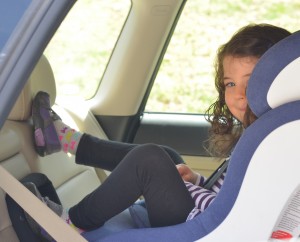 A kid tin can exist either also heavy, too alpine, or both–merely all of this depends on the specifcations of the car seat. Each auto seat has its own height and weight limits for rear-facing children. Well-nigh convertible seats allow children to sit rear-facing up to 35, 40 or 50 pounds. The peak limit for most rear-facing machine seats is that at that place must be at to the lowest degree 1 inch of room between the superlative of the child's caput and the acme of the machine seat. This inch ensures that as the child slides up the seat in a crash, his head will stay protected. Given the pattern of most car seats, the majority of children become too alpine for rear-facing seats before they go too heavy. Therefore, when yous purchase a convertible car seat, try to select one that is taller in seated height.
What about big kids – those who are "off the charts"?
A 95th percentile kid may wait stronger than his 5th percentile friend, but in a crash the bigger child is More at adventure if he's riding frontwards-facing. The rigidity of bones and the force of ligaments in the spine is likely the aforementioned in children of the same age, no matter their size. And a 95th percentile baby likely has a much larger, heavier head, which will pull forrard which much more force than that of a fifth percentile kid. Click hither to learn about seats that can best accommodate the biggest kids rear-facing.
What if my child is unhappy riding rear-facing?
Rear-facing does not have to exist ho-hum! Older kids tin ride quite upright so they can run across out the side and rear windows. If at that place is a head rest blocking your child'south view out the back window, yous can unremarkably remove it. By nine-12 months your infant knows yous're there when yous talk to them from the front end – even though they can't see you. And then y'all tin can calm and entertain your kid with songs, stories – and for older children games of "I spy" – all while they are rear-facing.
Nosotros've got lots of suggestions for corking automobile seat & travel toys for babies & toddlers (and big kids besides) – bank check them out here – because sometimes we all get a little cranky when nosotros're bored!
What are some good toys for rear-facing kiddos?
We've got a pediatrician-curated option of toys, teethers, and games that are car seat & travel friendly for babies, toddlers & big kids. Nosotros all get a little cranky when we're bored – and these are certain to keep colorlessness at bay!
What about kids who get motion sick?
The long and brusk: most kids do non puke less when forward-facing compared to rear-facing.
We've got lots of information on motion-sickness over here – including an caption of why it is believed to occur, things you tin can practise to decrease the hazard of your kid puking, and how to minimize the mess and clean upward if your child does puke.
I already turned my 1 twelvemonth one-time frontwards-facing – should I really plow her dorsum rear-facing?
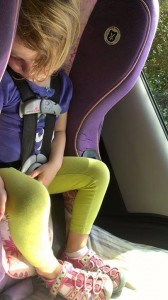
Aye! When we know better, we must do better. Iii months ago when y'all turned her frontward facing you did what y'all thought was best, merely now you know differently. Avoid regrets, and requite her the best protection.
Many parents worry that it will exist a disaster turning an older child dorsum rear-facing. Hither is one mom's experience turning her almost-three-year-old son back rear-facing:
"I was initially very hesitant to motility my almost three twelvemonth old son to rear facing from forwards facing. He has been sitting frontwards facing for over a year and can be strong willed when it comes to change. Nonetheless, after hearing how much safer it is I was willing to try. The offset three or and so drives were very difficult as he asked to "look out mama and dada's window" virtually the unabridged time. We ignored and distracted and I was about to give up when I noticed that although he withal complained most sitting rear facing information technology happened less and less. Now (afterward about three weeks) he asks maybe once every other drive if he can sit down forward facing and was even (more often than not) fine the other day when his friend joined us and saturday frontward facing. It was a tough kickoff few drives, but I am very happy we did it and I feel and so much safer.
I already turned my ane year former forward-facing – should I really turn her back rear-facing?
Yes! When we know meliorate, we must do amend. Iii months ago when you turned her forward facing you did what you idea was best, but now you know differently. Avoid regrets, and give her the all-time protection.
Many parents worry that it will be a disaster turning an older child back rear-facing. Here is 1 mom's experience turning her almost-three-year-old son back rear-facing:
"I was initially very hesitant to motion my almost three year old son to rear facing from forward facing. He has been sitting forrad facing for over a year and can exist strong willed when information technology comes to change. However, after hearing how much safer it is I was willing to effort. The first three or so drives were very hard as he asked to "await out mama and dada's window" almost the entire time. We ignored and distracted and I was most to give up when I noticed that although he still complained about sitting rear facing it happened less and less. Now (later on most three weeks) he asks perchance once every other drive if he can sit forrad facing and was even (mostly) fine the other twenty-four hour period when his friend joined us and sat forwards facing. It was a tough offset few drives, simply I am very happy we did it and I feel and so much safer.
My xx-month-erstwhile is likewise heavy for rear-facing in his electric current seat – should I really buy a different seat so he tin can ride rear-facing longer?
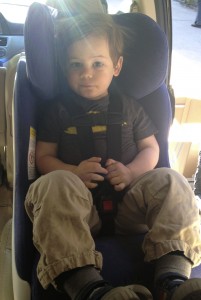
Imagine it'due south November and your 20-month-erstwhile has outgrown all of her wintertime clothes from last year. Would you not buy her new winter clothes considering "information technology will be warmer in 4 months"? The car seat is one of the only products you volition always purchase for your child that has the potential to save her life! Just like your kid needs new clothes frequently, they may demand a new car seat sooner than you thought. If you are in a crash, y'all volition be relieved knowing that you gave her the best protection possible.
What is the law?
The laws of physics don't intendance about the laws of the state… but with that said, it is now law in 15 states that children ride rear-facing until at least age ii.
- California
- Connecticut
- Illinois
- Louisiana
- Maine
- Nebraska
- New Jersey
- New York
- Oklahoma
- Oregon
- Pennsylvania
- Rhode Island
- South Carolina
- Virginia
- Washington
What is the prove?
It is critically important to understand that the recommendation to keep children under age 2 rear-facing is non based on a single study, but rather on a broad trunk of research from the United states and Sweden. These citations are included beneath for easy reference.
- Sherwood CP, Crandall JR. Frontal sled tests comparison rear and forrard facing child restraints with 1-iii twelvemonth onetime dummies.Almanac Proceedings of the Association for the Advancement of Automotive Medicine. Clan for the Advocacy of Automotive Medicine, 2007,51: 169-80.
- Planath I, Rygaard C, Nilsson Due south. Synthesis of data towards neck protection criteria for children.Proceedings of the 1992 International IRCOBI Briefing on the Biomechanics of Impacts. Verona, Italian republic:155-66.
- Kamren B, Koch 1000, Kullgren A, et al. The protective effects of rearward facing CRS: an overview of possibilities and problems associated with child restraints for children aged 0-3 years.Child Occupant Protection Symposium: SAE International, 1993.
- Klinich KD, Manary MA, Weber KB. Crash protection for kid passengers: rationale for best practice.UMTRI Res Rev 2012;43:1-35.
- Isaksson-Hellman I, Jakobsson L, Gustafsson C, et al. Trends and effects of kid restraint systems based on Volvo's Swedish accident database.41st Stapp Motorcar Crash Conference: SAE International, 1997.
- Jakobsson L, Isaksson-Hellman I, Lundell B. Rubber for the growing child: experiences from Swedish accident data.Proceedings of the 17th ESV Conference, 2005.
- American Academy of Pediatrics, Committee on Injury, Violence & Poisonous substance Prevention. Child Passenger Safety. Pediatrics. 2018.
- Arbogast KB, et al. Injuries to Children in Forwards Facing Kid Restraints. Almanac Proceedings Association for the Advocacy of Automotive Medicine. 2002; 46: 213-30.
We are a reader supported site. We earn an affiliate commission when you purchase through our links.
FTC Disclosure: Affiliate links are included in this folio. No budgetary compensation was provided, still, some of the reviewed products were supplied by the manufacturer or distributor to help facilitate the review. All opinions are those of The Car Seat Lady LLC.
Source: https://thecarseatlady.com/when-should-your-child-turn-forward-facing/
0 Response to "That Age Do You Put Your Baby in a Frount Fasing Carseat"
Post a Comment